

Ultra Processed Foods : Why are we talking about it ?
You’ve surely heard about ultra-processed foods these past few weeks. Whether in the media, on social networks, or in the National Assembly, the subject is everywhere. Between the publication of three new Inserm studies in May 2026 and the debates emerging in Parliament, these products are more than ever in the spotlight.
A collective awareness of their potential health effects finally seems to be emerging. And it’s about time!
What is an ultra-processed food?
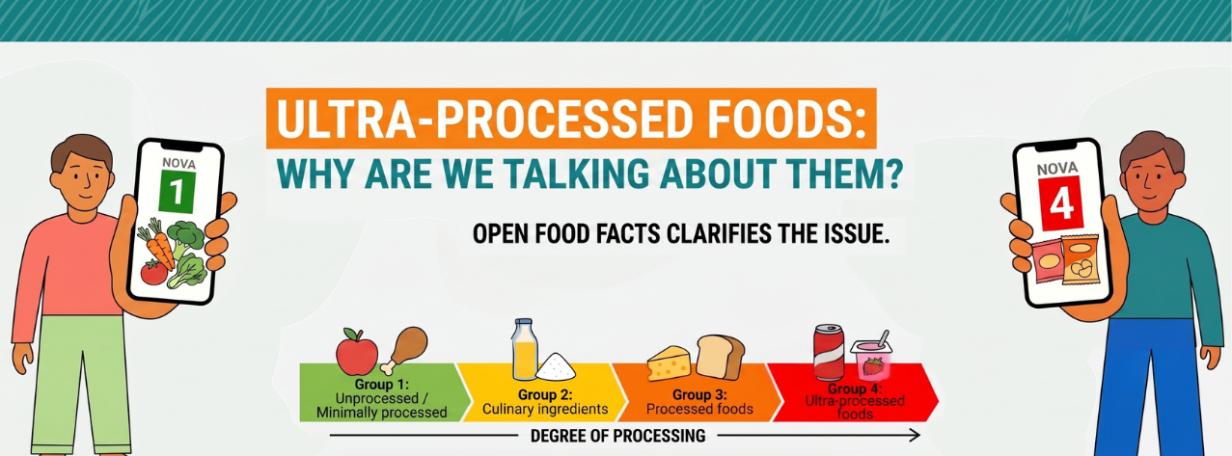
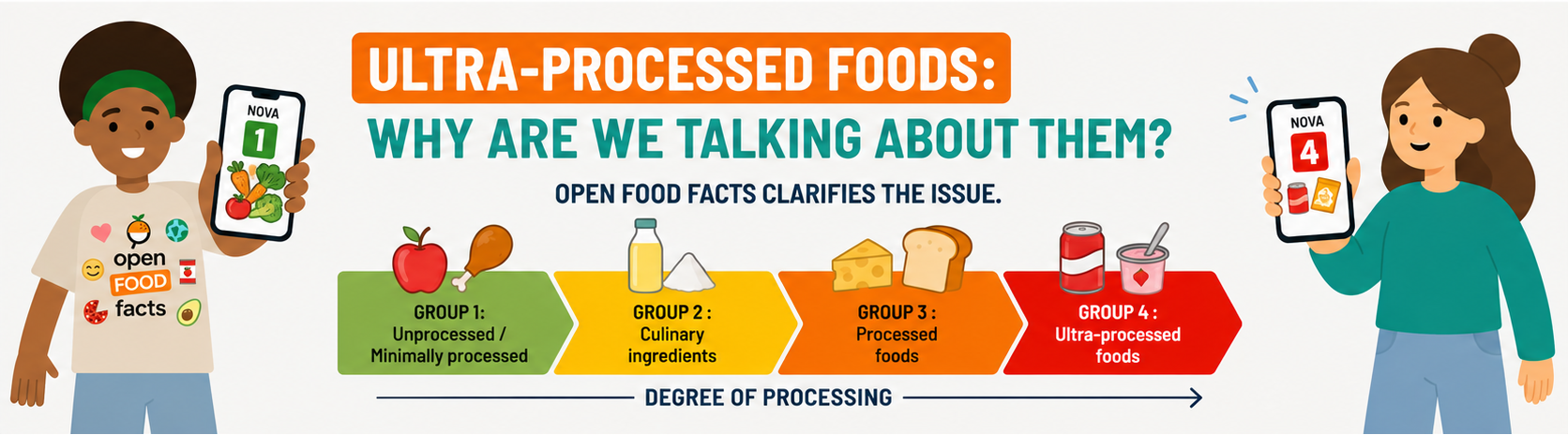
Everything starts with the NOVA classification, developed in 2009 by Professor Carlos Monteiro and his team at the University of São Paulo. NOVA divides foods into four groups according to their degree of industrial processing, rather than their nutritional composition.
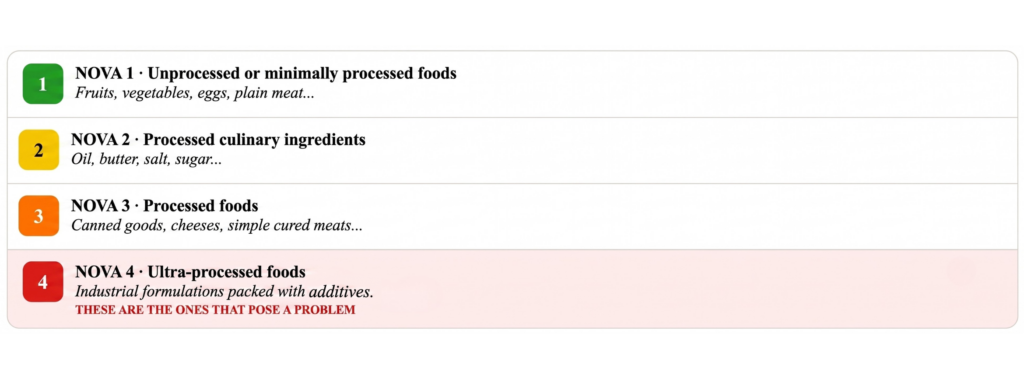
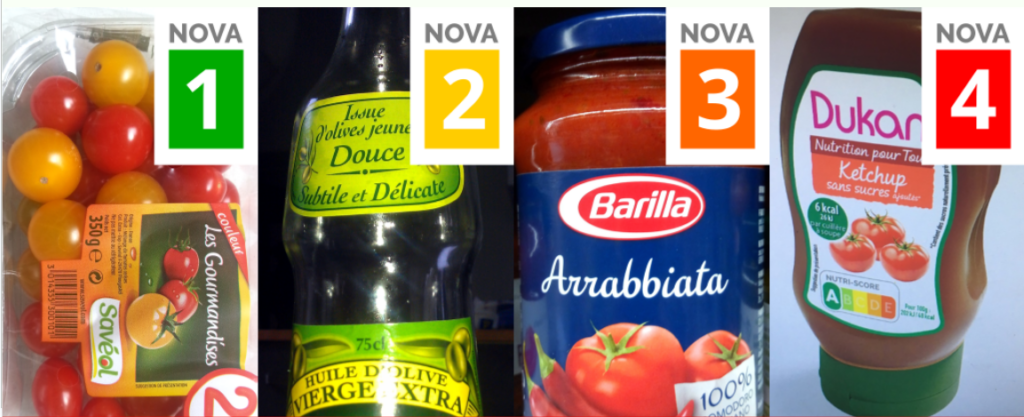
These are the ones that pose a problem. Group 4 refers to products that no longer really resemble food in their natural state: they are industrial formulations built from extracted or synthesized ingredients, designed to be cheap, hyper-palatable and long-lasting.
A plain yogurt is NOVA 1, a flavored yogurt with cosmetic additives becomes NOVA 4. Or an industrial sandwich bread with emulsifiers and acidity regulators: NOVA 4.
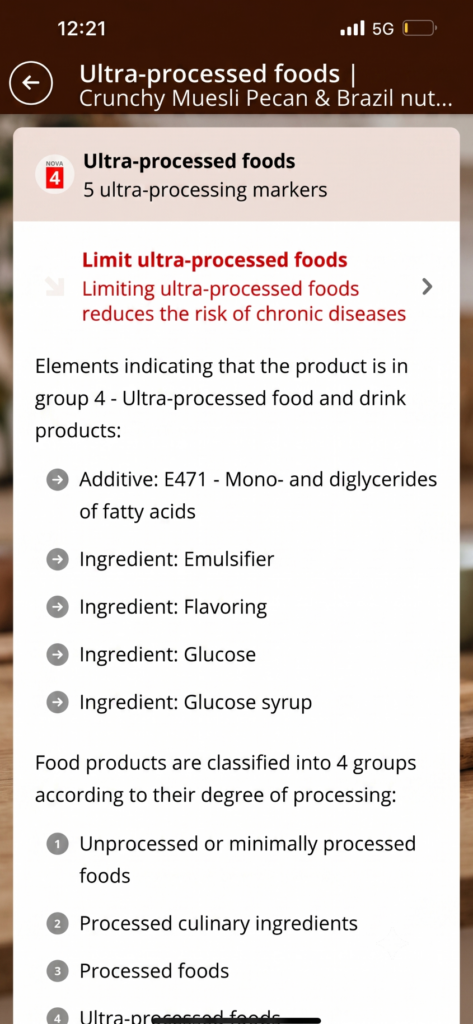
The identification method is simple: you look at the ingredients list. The presence of non-culinary ingredients (hydrolyzed proteins, glucose-fructose syrup, chemically modified starch…) or “cosmetic” additives (colorings, sweeteners, emulsifiers, flavor enhancers…) is a marker of ultra-processing.
Open Food Facts and NOVA: since 2019
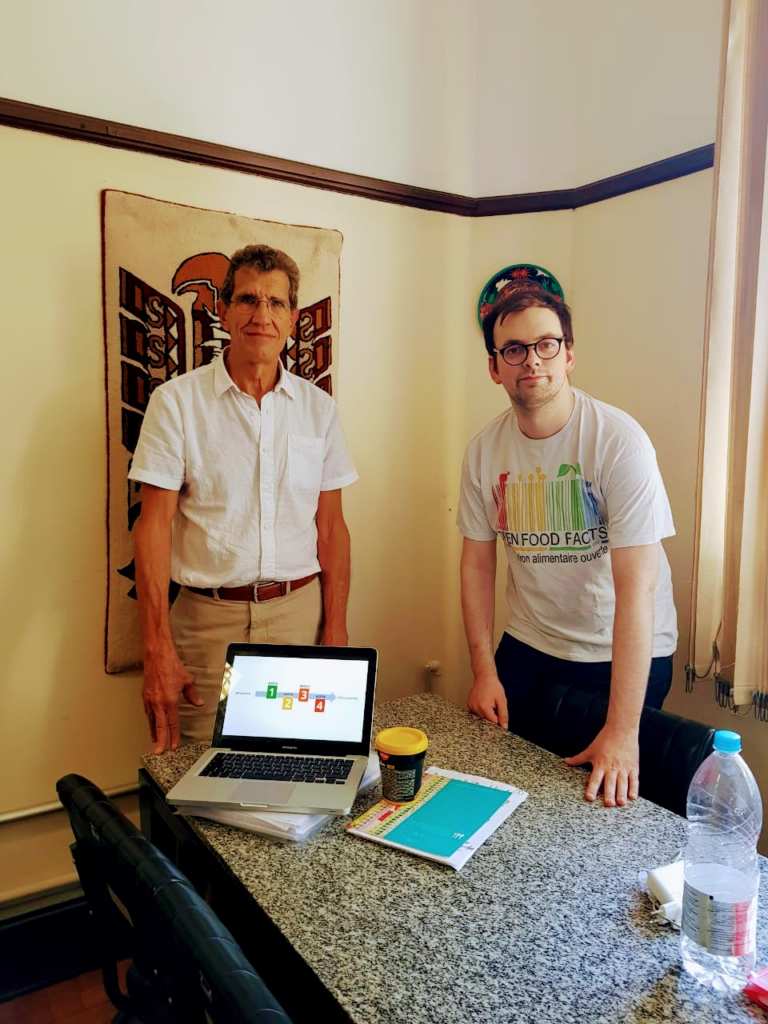
In April 2019, Pierre Slamich, co-founder of Open Food Facts, flew to São Paulo to meet Professor Carlos Monteiro in person. A meeting arranged at the last minute, a journey across the city, and the beginning of a collaboration that continues to this day.
Since that date, Open Food Facts has been calculating and displaying the NOVA score on all products in its database, alongside the Nutri-Score and the Green-Score. On the website, in the mobile app, and on the professional platform. This work is done in direct collaboration with Prof. Monteiro’s scientific team: we regularly submit our markers for their review, provide them with data, and continuously refine the calculation algorithm..
A database in the service of science
This is not just a display. Open Food Facts’ NOVA data is an open resource, used by consumers, researchers, and journalists around the world. This is precisely why Open Food Facts exists as a free and open database: so that science can advance, public policies can be built on real data, and every citizen can know what they eat.
More than 10 scientific studies have used the Open Food Facts database to analyze ultra-processed foods, in countries as diverse as France, Brazil, Spain, and the United States.
It is for example from our data that a team of researchers from Inserm was able to map, in 2020, the presence and combination of hundreds of food additives across 126,000 products on the French market, revealing that ultra-processed foods contain on average far more additives than others, and that certain ones are systematically found together. A study published in Scientific Reports, the Nature group journal.
What science says: the evidence is mounting
And science is moving fast. In November 2025, a series of three articles published in The Lancet synthesized the current knowledge on the health impacts of UPFs (ultra-processed foods), drawing in particular on the French NutriNet-Santé cohort. This work shows significant associations between ultra-processed food consumption and twelve health problems, including obesity and depression.
In May 2026, three new Inserm studies, supervised by Mathilde Touvier, research director, were published in Diabetes Care, the European Journal of Epidemiology, and the European Heart Journal. They focus on the effects of specific additives (colorings, preservatives, antioxidants) on a cohort of more than 100,000 people followed since 2009. The results further strengthen the existing body of evidence.
Lawmakers are finally taking action
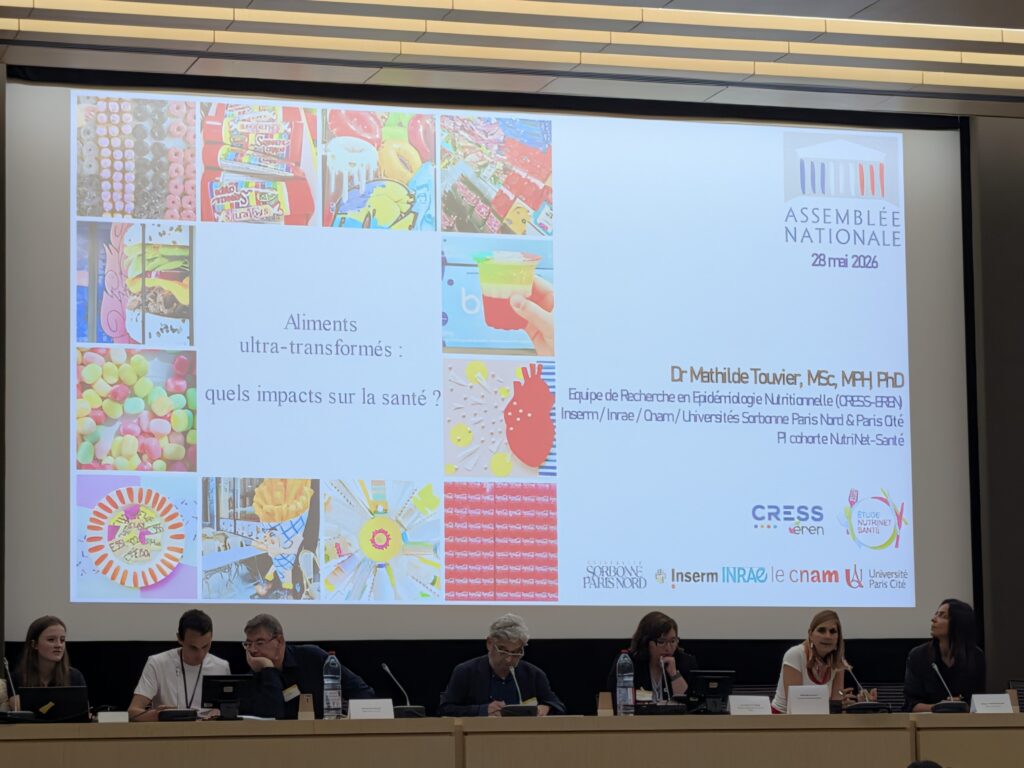
On May 28, 2026, a symposium dedicated to ultra-processed foods was held at the National Assembly, organized by members of parliament Loïc Prud’homme and Sabrina Sebaïhi. Pierre Slamich (Open Food Facts) took part in a roundtable on civic and policy levers: how to identify UPFs, and what role initiatives like Open Food Facts can play.
This symposium is not an isolated event. A bill is currently being prepared to regulate ultra-processed foods: mandatory labeling on packaging, advertising restrictions, plain packaging for NOVA 4 products. Measures comparable to what has been put in place for tobacco, but applied to industrial food.
We are glad that this battle of ideas, carried by researchers, associations, and committed citizens for years, is now finding resonance at the legislative level.
You too can take action
Open Food Facts is a collaborative database, built by and for citizens. Every scan, every label photo, every correction counts. The more complete the database, the more useful the data: for you, for researchers, for decision-makers.
Scan your products in store, discover their NOVA group, and help make food more transparent for everyone.Scannez vos produits en magasin, découvrez leur groupe NOVA, et contribuez à rendre l’alimentation plus transparente pour tous.
Download the free Open Food Facts app and join the millions of contributors worldwide.